Sorry for the hysterical tone of yesterday's post. Unfortunately for my recovery, I found out about the Maltese bishops around 11 PM, when I ought to have been in bed, and I couldn't sleep. Result: anguish and relapse. I fell asleep around 6 AM after much praying and weeping, and I spent yesterday flat on my back, dozing in two hour snatches. When I woke up, I applied microwaved washcloths to my aching face.
"If I'm in so much pain with just a cold, how am I going to cope with cancer?" I asked B.A.
"You're not going to get cancer," said B.A.
Given family history, I'm more likely to have a stroke, as I thought whenever yet another coughing fit caused a throbbing in my left temple. I banished the computer from the guest room and forbid B.A. from discussing Church news. The only Church news I wanted was that the Cardinals and bishops had risen up to correct the Maltese heresiarchs, and I didn't want to brood on how unlikely this was.
When B.A. came back from the mall with groceries and eucalyptus oil, he took up residence in the armchair by the empty fireplace at the end of this long but narrow room. This was very kind and companionable of him, as was his preparation of a bowl of steaming eucalyptus. This nursing stuff is more frequent to men in romance novels than to men in real life, so I must have looked as sick as I felt.
"May God bless you for your care of your wife," said I.
A Christian therapist once told me that the most authentic prayer is "Help!" When I think of the family emergencies that knocked me to my knees---once while I was washing dishes--I believe that. As we didn't pray nightly rosaries in my family, the rosary seems like more of a private devotion or--because I only really began to pray it when I joined the local teen pro-life movement--spiritual warfare. If we believe Sister Lucia of Fatima, however, we believe that we should pray the rosary every day. In the small hours of Saturday morning, I finally turned to the rosary, but not after some time with my childhood prayer book. "Prayer for the Church" really made me cry.
Anyway--relapse.
I strive in my blogging and other writing not to come across as the legendary "Mad Trad". However, the Church is in such an emergency that all believing Catholics--trad, neo-con, liberal--should be tearing our hair and rending our garments. Mad, no. Sad, yes. When Saint John Paul II was elected in 1978, he began to cope with the terrible mess caused by the aftermath of the Second Vatican Council. Over almost 30 years he created a wonderful edifice of papal doctrine that addressed contemporary life and problems. Now this brilliant work has been thrust aside--or, worse, pillaged for half-quotes-- in favour of craven banalities.
It's not an original thought--bear with me, for I am still in bed--but it seems that there are at least two different Catholicisms out there. The one that seems most prominent is the world-focused one, which is all about creating heaven on earth and making everyone feel as happy and comfortable as possible. In this Catholicism, the Eucharist is primarily a symbol of community. This Catholicism has a lot going for it: the corporal works of mercy are very important, after all.
The next most prominent one is focused on God, the Mother of God, heaven, purgatory and hell. In this Catholicism sin is not a trivial human weakness that should not be judged but a personal calamity with the most awful consequences. And in this Catholicism, the Eucharist is primarily the Body, Blood, Soul and Divinity of Our Lord Jesus Christ, worthy of our adoration and--scandal to the Protestants--worship.
The Marian piety of this Catholicism is strongly influenced by the incidents and personalities involved in the apparitions of Lourdes and Fatima. Saint Bernadette died young, but Sister Lucia of Fatima lived to a ripe old age, and so arguably had greater influence. (St Bernadette, like the Little Flower, seems to have belonged to a different age entirely.) There is also an obsession around her "secret"--there was but one "secret" originally--which became three "secrets", two revealed after they had come to pass, and one that seems to have disappointed many people.
Personally, I am less interested in the Secret than in Lucia's concern for souls going to hell. By her account, her two infant cousins were also very worried about souls going to hell. They were so worried about this, they apparently spent most of the rest of their young lives praying and doing penance in the hope that they would save these souls. Lucia reported that the children even hurt themselves with rope cilices. (Their father said he knew nothing about that, which is to his credit.)
It would seem that these two children were a lot more worried for the souls of their fellow human beings in general than the Maltese bishops are for the souls of Maltese Catholics who commit serious sexual sins. Instead of investigating thoroughly whether or not sexual sins really do send souls to hell---and Sister Lucia was very firm in saying that they did--the Maltese bishops have instead encouraged these people to risk receiving the Eucharist, which---let me tell you--in equally Catholic Poland sexual sinners do not do.
It's interesting, you know. In some countries, the Catholics are so honest about their sins and yet so respectful of the Holy Eucharist that they do not receive the Eucharist until they have made their confession and promise of amendment. For many this may be when they stop using birth control. In Canada I knew a Polish lady who had married a divorced man, and although she went to Sunday mass every week, she did not approach the Sacrament. I thought her situation was very sad, but I honoured her for her respect and love for the Eucharist and refusal to use it as a symbol of "I'm okay, you're okay".
Although it is obviously far from the idea that large numbers (most?) Catholics use birth control or commit other long-term sexual sins, it is surely better that they have a reason to give them up than an excuse to keep doing them. It is also better that the Church teach the truth in and out of season than to be the cool uncle who invites you to smoke pot with him.
Sunday, 15 January 2017

Saturday, 14 January 2017

Friday, 13 January 2017
Falco Explained
Normally I do not regret that that there was no internet in the 1980s. However, as there were no liner notes to our Falco singles and CDs, youtube would have come in handy. These go out to my German-learning, fellow Falco fan Nulli Secundus:
(See notes for lyrics to "Nie mehr Schule")
And a Nena bonus:
And a Nena bonus:
Roused by Song
 Well, maybe not song, exactly. (That's the motto of one of my clans, by the way.) More like roused by love of teaching. Having postponed Wednesday's Ancient Greek class to Friday, I was determined to be well enough to teach today. When I woke up at 2 AM with a splitting headache, I groaned with disappointment.
However, I reread parts of Lalka until I fell asleep again, and when I woke up at 9, I waited out my first four hours of misery to see if I would feel well enough to take a shower, get dressed and walk to the train station. Happily I did. I left early enough to walk slowly.
Baby, it was cold outside. However, the important thing is that the whole adventure--walk 20 minutes - train - walk 15 minutes - teach - walk 15 minutes - train - walk 20 minutes--took only 3 hours, and it has been a dry day, so I never felt damp. Now I shall wait and see if I feel even better tomorrow or have another relapse.
I am not usually that interested in my health, but it has been an interesting six weeks from a tissue manufacturer's point of view. My glasses are still firmly on my nose, as I have felt too poorly to find out if I can wear contact lenses again. And I am certainly not going to anything strenuous until this cold is clearly over.
Today's class included the Present Tense of (most) verbs and the first declension feminine and second declension masculine, nominative and accusative, singular. Hopefully that was not too much to introduce all in one hour. Fortunately, my charges know Latin and are keen.
Thursday, 12 January 2017
"Lalka" (The Doll)
My companion in illness has not been B.A. as much as Lalka ("The Doll") by Bolesław Prus (1890, translated by David Welsh), because Prus--who I see was also Głowacki (hence all those Polish cultural things called Głowacki this or that)--cannot catch this hideous cold. He died in 1912.
It is a testament to the genius of Głowacki/Prus that I have read his 676 page book almost non-stop, taking breaks only for meals, naps, Endeavour, and pacing the floor of the guest room, in which I am quarantined. One charming aspect of this illness is that it allows me only two hours of sleep at a time, and when I awake I feel quite wretched. However, four hours after giving up on sleep, I feel rather better and can read again. Such an absorbing doorstopper of a nineteenth century book has been just the thing.
Sadly, it is the most misogynist book I have ever read. Thank you, Polish Romantics. Really, the only likeable woman in all of Lalka is a 70 year old duchess, and that is quite something, as the book is also an acid attack on the old Polish class system, especially the aristocracy.
Between them, the Germans and the Soviets liquidated most of the Polish aristocracy during the Second World War, which arguably ended in Poland only in 1989. While researching an article on Poles in Scotland, I was saddened by the information that the Polish soldiers marooned here by Britain's betrayal of the Free Polish government in London in favour of the Slave Polish government in Warsaw were told that they might be called into active service to liberate Poland. Goodness knows how long the true believers waited for the call that never came. The generals took up menial jobs and returned only after the Berlin Wall fell.... It's a very sad story, and something for the British to feel guilty about should they ever tire of feeling guilty about their great and glorious Empire.
Anyway, back to Lalka. Lalka is highly reminiscent of the works of Dickens, Henry James, and Dostoyevsky. The blurb on the cover says Chekhov, but Chekhov was a short story man, so I myself am thinking Feodor. Also, the book is highly moral with lots of conversations about virtue and vice. But the more I read, the more I thought about The Portrait of a Lady, only the Isabel Archer character is a brilliant businessman named Stanisław Wokulski. You will not find any women like Isabel Archer in Lalka, that's for sure.
There is a spirited proto-feminist character named Mrs Wąsowska. The women in the book are either stupid, stupid and wicked, or clever and wicked. Mrs Wąsowska is clever and wicked, so rather interesting. She does her best to defend the bad behaviour of Polish aristocratic women who flirt with every man alive, marry horrible old men for money and have affairs. The cool thing here is that Prus levels the playing field between the two combatants----his hero married an older woman (now dead) for her money (or, rather, for a job in her shop) in his youth, so he he knows all about selling oneself. The difference is that he kept his side of the bargain, unlike the silly girl he and Mrs Wąsowska are arguing over.
As I read hundreds of pages of a nouveau riche chap's misery over the entitled snob with whom he was infatuated, I felt rather impatient with him for being quite so stupid. However, I have had two-year long crushes myself, so I know they can be hard to escape. But I was very interested in his sulkiness over aristo women flirting with every man around, for it struck me that I knew the philosophy behind this activity first hand.
When I was in elementary school, there was a pecking order among the girls based on whether the boys "liked" us or not. By "like" we didn't mean, "thought was one of the boys"--indeed I knew only one girl like that: all the boys liked her sincerely without "liking" her. By age 11, I knew that it was a shameful thing not to be "liked" by any boy and by age 14, that it was shameful to be "liked" by the wrong boy. My first cavalier, whom I met on a two-school retreat, took quite a shine to me, but his classmates told my classmates that his father was a garbage collector (i.e. bin man) and this caused great hilarity.
When I was in high school, there was neither a pecking order nor boys most of the time, but I still got the message that the more boys who "liked" you, the better it was. My frivolous heart sang with joy when the Candygram lists were posted, and multiple marks appeared after my name. It's funny that our grades were never posted, but any girl could see how many billets-doux had arrived for the others.
There was also my mother, who was very interested in my tales of high school dances and took an obvious satisfaction in the number of boys who asked me to dance. She was not at all interested in the number of boys I asked to dance; she said that they didn't count, which implied that the ones who asked did. Again: the more, the better.
There were also most books written for girls and women before 1970, which implied--or said flat out--that it was a good thing to have many suitors to choose from. Well, look at Scarlett O'Hara. The whole point of Scarlett's pre-war existence was having a gazillion men around. And I must say, that there is no woman men seem to take more interest in than a woman all the other chaps take an interest in.
Now here's a thing. There were girls in my elementary school class it was okay for a chap to have a crush on, and there were girls (including me) whom it was de rigeur to scorn. I did not have a flirtatious bone in my body until high school when I was so happy to be out of that milieu, I somehow found my Inner Scarlett and did what she said. Result: a mild popularity, i.e. boys enough to dance with. No doubt I confused a lot of already confused high school boys and I definitely hurt some adolescent feelings, but Society had told me from the age of eleven that being found unattractive to boys and men was shameful, so what was I to do? Nobody handed me Lalka and said "Here, read this highly disapproving Polish novel."
Besi the iddes,ea that you can win the love of a good man (let alone a prom date) with modest clothing, downcast gaze and high ideals about men is rather amusing. It does happen--and I know a woman that happened to before she was too old to have babies--but more frequently it does not. What wins a man most frequently is being a washed and healthy average woman who goes along with the current social norm. If the social norm is sex-on-the-third-date, then chaste Catholic girls are at a serious disadvantage in that society.* Heavens, the one under-70 woman in Lalka who does not flirt and flutter like a demented sparrow is positively miserable.
Anyway, the wickedness of flirtatious women is only a quarter of the book. There is also an exploration of the relationships between the Polish aristocrats, the Polish Jews and the Polish Everybody Else. There is also the most amazing pen portrait of Paris in the 1870s that I have ever come across. My one disappointment is that the hero never does go (as promised) to Moscow, for I longed for a Polish-eye-view of 1870s Moscow, too.
And now I feel rotten so I am going back to bed. Ugh.
*Update: One solution, of course, is to frequent Catholic circles as much as possible and not dismiss boring-looking Catholic guys as actually boring until adequate research has been done. Another solution is to concentrate on your studies or money-making until men your age have grown up.
There is a spirited proto-feminist character named Mrs Wąsowska. The women in the book are either stupid, stupid and wicked, or clever and wicked. Mrs Wąsowska is clever and wicked, so rather interesting. She does her best to defend the bad behaviour of Polish aristocratic women who flirt with every man alive, marry horrible old men for money and have affairs. The cool thing here is that Prus levels the playing field between the two combatants----his hero married an older woman (now dead) for her money (or, rather, for a job in her shop) in his youth, so he he knows all about selling oneself. The difference is that he kept his side of the bargain, unlike the silly girl he and Mrs Wąsowska are arguing over.
As I read hundreds of pages of a nouveau riche chap's misery over the entitled snob with whom he was infatuated, I felt rather impatient with him for being quite so stupid. However, I have had two-year long crushes myself, so I know they can be hard to escape. But I was very interested in his sulkiness over aristo women flirting with every man around, for it struck me that I knew the philosophy behind this activity first hand.
When I was in elementary school, there was a pecking order among the girls based on whether the boys "liked" us or not. By "like" we didn't mean, "thought was one of the boys"--indeed I knew only one girl like that: all the boys liked her sincerely without "liking" her. By age 11, I knew that it was a shameful thing not to be "liked" by any boy and by age 14, that it was shameful to be "liked" by the wrong boy. My first cavalier, whom I met on a two-school retreat, took quite a shine to me, but his classmates told my classmates that his father was a garbage collector (i.e. bin man) and this caused great hilarity.
When I was in high school, there was neither a pecking order nor boys most of the time, but I still got the message that the more boys who "liked" you, the better it was. My frivolous heart sang with joy when the Candygram lists were posted, and multiple marks appeared after my name. It's funny that our grades were never posted, but any girl could see how many billets-doux had arrived for the others.
There was also my mother, who was very interested in my tales of high school dances and took an obvious satisfaction in the number of boys who asked me to dance. She was not at all interested in the number of boys I asked to dance; she said that they didn't count, which implied that the ones who asked did. Again: the more, the better.
There were also most books written for girls and women before 1970, which implied--or said flat out--that it was a good thing to have many suitors to choose from. Well, look at Scarlett O'Hara. The whole point of Scarlett's pre-war existence was having a gazillion men around. And I must say, that there is no woman men seem to take more interest in than a woman all the other chaps take an interest in.
Now here's a thing. There were girls in my elementary school class it was okay for a chap to have a crush on, and there were girls (including me) whom it was de rigeur to scorn. I did not have a flirtatious bone in my body until high school when I was so happy to be out of that milieu, I somehow found my Inner Scarlett and did what she said. Result: a mild popularity, i.e. boys enough to dance with. No doubt I confused a lot of already confused high school boys and I definitely hurt some adolescent feelings, but Society had told me from the age of eleven that being found unattractive to boys and men was shameful, so what was I to do? Nobody handed me Lalka and said "Here, read this highly disapproving Polish novel."
Besi the iddes,ea that you can win the love of a good man (let alone a prom date) with modest clothing, downcast gaze and high ideals about men is rather amusing. It does happen--and I know a woman that happened to before she was too old to have babies--but more frequently it does not. What wins a man most frequently is being a washed and healthy average woman who goes along with the current social norm. If the social norm is sex-on-the-third-date, then chaste Catholic girls are at a serious disadvantage in that society.* Heavens, the one under-70 woman in Lalka who does not flirt and flutter like a demented sparrow is positively miserable.
Anyway, the wickedness of flirtatious women is only a quarter of the book. There is also an exploration of the relationships between the Polish aristocrats, the Polish Jews and the Polish Everybody Else. There is also the most amazing pen portrait of Paris in the 1870s that I have ever come across. My one disappointment is that the hero never does go (as promised) to Moscow, for I longed for a Polish-eye-view of 1870s Moscow, too.
And now I feel rotten so I am going back to bed. Ugh.
*Update: One solution, of course, is to frequent Catholic circles as much as possible and not dismiss boring-looking Catholic guys as actually boring until adequate research has been done. Another solution is to concentrate on your studies or money-making until men your age have grown up.
Wednesday, 11 January 2017
So Sick
I've cancelled everything and am lying in bed. I will turn off the computer and spend the rest of the day reading Lalka by Boresław Prus. To be precise, the English translation of Lalka, i.e. "The Doll."
Now to make a hot toddy. I do not want a hot toddy. I want orange juice, chicken soup and buttered toast. However, whiskey, sugar and lemons is what I have.
I feel wretched and want my mother. And a new toaster. And some bread.
Now to make a hot toddy. I do not want a hot toddy. I want orange juice, chicken soup and buttered toast. However, whiskey, sugar and lemons is what I have.
I feel wretched and want my mother. And a new toaster. And some bread.
Tuesday, 10 January 2017
'O Didaskalos
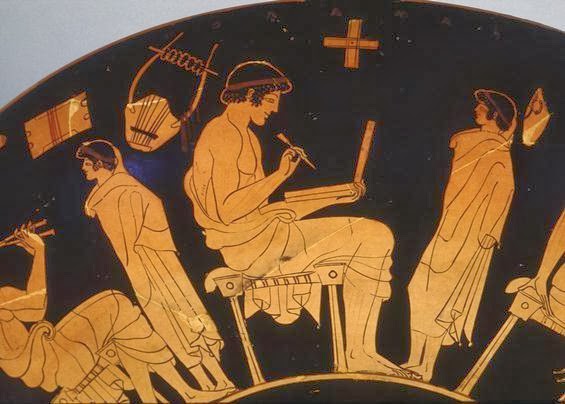
If I am sick from simply going out of doors, it was worth it, for yesterday I taught my first class in Ancient Greek and remembered how much I love teaching. Besides that, it's wonderful to be getting to grips with Ancient Greek, which is not as much a passport to the minds of the ancients--for their greatest works have been translated into English--as it is to the experience of those young men of the European ruling/educated classes who studied Ancient Greek as a matter of course.
Sadly, I told my pupils a whopper about Sir Patrick Leigh Fermor and the German general he kidnapped in Greece during the Second World War becoming firm friends over a shared knowledge of Homer. I have just looked up the story, and it wasn't Homer, it was Horace. From the Telegraph obit:
Gazing up at the snowy peak, Kreipe recited the first line of Horace's ode Ad Thaliarchum – "Vides ut alta stet nive candidum Soracte" (See how Soracte stands white with snow on high). Leigh Fermor immediately continued the poem to its end. The two men realised that they had "drunk at the same fountains" before the war, as Leigh Fermor put it, and things between them were very different from then on.
Now I shall have to tell my pupils I misremembered. Oh, alas. I was also a bit vague on the location of Ancient Phoenicia. I was right that the Phoenician empire included Carthage, but it turns out Phoenicia itself was on the shores of the eastern Mediterranean. Now I shall have to tell them that, too. Oh, for the dusty pull-down maps of the classrooms of my youth.
One splendid aspect of my new job is that my charges very much want to learn Ancient Greek. When I taught English writing skills at a community college, I was fortunate that the majority of my students really wanted to be there and desperately wanted to do well. They were usually mature adults who had struggled in high school and were glad to have a second chance. The most difficult students were permanently bored, time-wasting adolescents who wanted to get through their college educations ASAP and get jobs as cameramen for the CBC, or whatever.
How these graduates were going to be effective in media without learning from their mandatory "Communications" class was not a question they seemed to ponder much. Fortunately this was before the era of the smartphone, and even more fortunately, such students were in the minority and only appeared in the summer courses. They did make me question whether I wanted a life of teaching adolescents, however.
Highly preferable was each term's "class hard-ass", whom I always liked. I respected his or her attitude of "Prove to me you have the chops to teach me anything", and all I had to do to prove this was worst him or her in a bit of banter. The class hard-ass then used his or her natural high spirits to make class fun and he or she wrote his or her compositions with great energy and humour.
The biggest difference between teaching English writing skills and Ancient Greek is that the latter takes an awful lot of prep. However, it is worth it. I am determined that my students will ace their GCSEs and, what's more, get all the intellectual and spiritual advantages of a Classical education.
Subscribe to:
Posts (Atom)